
In 2026, the global labor market is defined by a strange paradox: while 52% of people report they are job hunting, the actual voluntary quit rate has hovered at a decade-low of approximately 2%. This phenomenon, often called “job hugging,” is driven by economic uncertainty and the collapse of the “job-switching premium,” which fell from a 2.2% wage advantage in 2023 to a mere 0.2% by early 2025.
If you feel stuck at a professional crossroads, you aren’t alone. Deciding whether to reinvest in your current role or seek a new frontier requires more than just a gut feeling—it requires a strategic audit of your well-being and alignment.
Recognizing the Red Flags
Most people don’t quit their jobs overnight; they quit the slow erosion of who they used to be. Before making a move, it is vital to distinguish between a “bad day” and an unsalvageable environment.
- Emotional Numbness: While many believe burnout looks like panic, the biggest red flag is often “emotional flatness” or numbness. If you have stopped caring or trying, the job has already cost you something deep.
- Stagnation and Skill Obsolescence: Data shows that 75% of workers leave their employer before ever receiving a promotion, with the average wait time for advancement stretching to 30.4 months. If your skills are no longer being utilized or you are not gaining new know-how, you risk becoming unattractive to future employers.
- The Toxicity Test: True toxicity is characterized by bullying, a lack of psychological safety, and leadership that rewards “survival behaviors” like people-pleasing and silence.
The Sunk Cost Trap
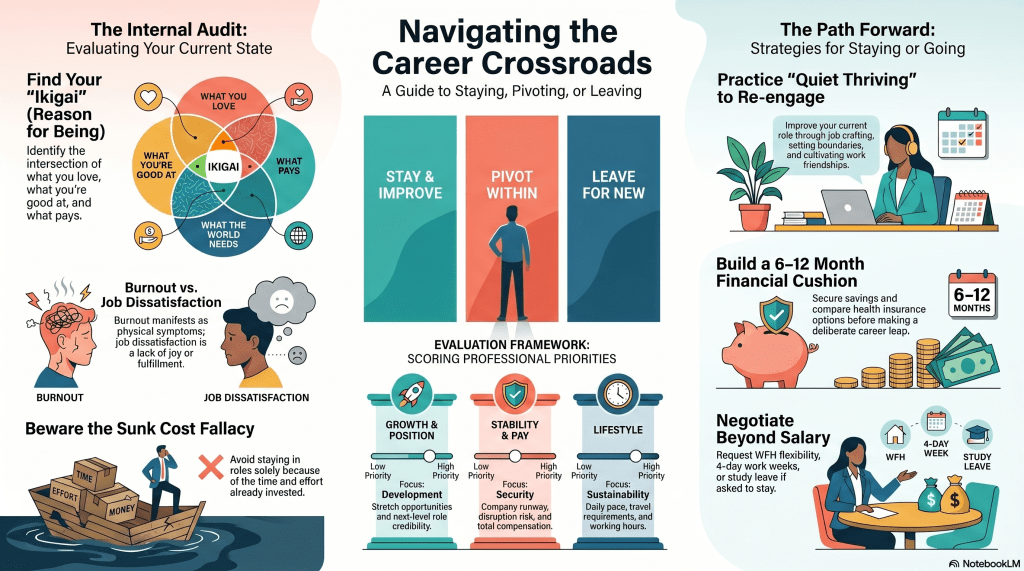
Why do we stay when we are unhappy? Often, we fall victim to the Sunk Cost Fallacy—the psychological bias where we continue to invest time and effort into a failing situation simply because we’ve already invested so much in the past. We fear that leaving will render those years of service a “waste”.
However, in 2026, loyalty is being redefined. It is no longer measured by years of tenure, but by the depth of contribution during those years. If a role provides income but lacks passion or contribution, you are staying for the “profession” but losing your “mission”.
Option A: The Path of Quiet Thriving
If the market is too volatile for a move, you may choose to “Quiet Thrive.” This is the antithesis of quiet quitting; it involves making intentional, subtle changes to feel more fulfilled without necessarily changing your job.
- Job Crafting: Proactively redefine your role. Task crafting involves shifting your time toward high-value tasks that energize you, while relational crafting focuses on building workplace friendships—which makes 57% of workers find their jobs more enjoyable.
- Set Intentional Boundaries: In a world of constant connectivity, thrivers set strict start and finish times and are disciplined about non-working hours to lower cortisol levels and prevent burnout.
- Celebrate Small Wins: Recording minor achievements combats imposter syndrome and keeps pessimism at bay.
Option B: The Strategic Quit
If you decide that an exit is necessary, it should be managed with logistical and financial precision.
- The 10/10/10 Rule: Evaluate your decision across three timeframes: How will you feel in 10 minutes, 10 months, and 10 years?. Quitting might feel great in 10 minutes, but without a plan, the financial strain in 10 months could lead to “Great Resignation” regrets—an issue currently affecting 8 out of 10 professionals who left their roles in recent years.
- Financial Readiness: Ensure you have an emergency fund covering 6–12 months of expenses. Be sure to spend your FSA funds and check vesting milestones for 401(k) or stock options before handing in your notice, as these are often forfeited upon exit.
What This Is Really About
At its core, this crossroads is not only about work. It is about whether your current path still reflects your values, your strengths, and your season of life.
That is where the idea of ikigai becomes useful: the intersection of what you love, what you are good at, what the world needs, and what can sustain you. In an age where AI handles more tasks, the qualities that remain deeply human — empathy, judgment, creativity, discernment — become even more valuable.
Whether you stay and reshape the role or leave to begin something new, the goal is the same: move with clarity, not panic. A good decision is not the one that looks impressive from the outside. It is the one that helps you become more fully yourself.


Leave a comment