
One morning, you catch your reflection in the mirror and pause—not because of new lines or gray hairs, but because you barely recognize the person looking back. You have spent decades doing everything you were “supposed” to do: building a career, raising a family, and checking off every box on a list you didn’t even write. Yet, despite life looking “fine” on the outside, you feel a persistent sense of “meh,” disorientation, or quiet desperation on the inside.
If you feel like you are following a “recipe” for a life you don’t actually like, you aren’t broken. You are experiencing a profound recalibration.
The Signs You Are Questioning Your Path
Feeling “lost” in midlife rarely starts with a dramatic explosion; it begins with insidious, painful nudges. Common signs include:
- Deep Sadness and Regret: Ruminating over perceived missed opportunities in your career or relationships.
- Restlessness: Daydreaming about what life would be like if you had chosen a different partner or career path.
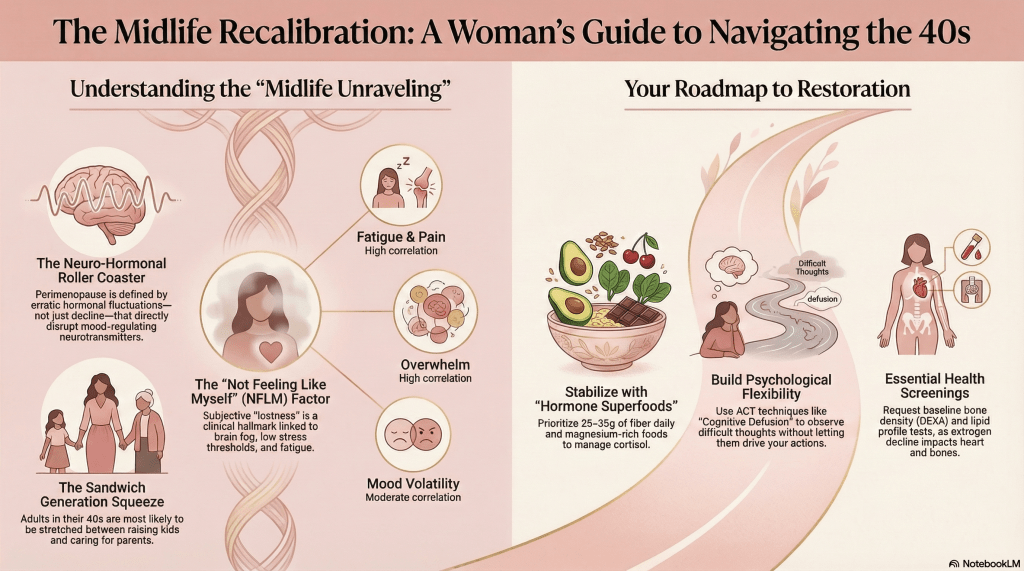
- The “NFLM” Phenomenon: Statistically, many women in their 40s experience “Not Feeling Like Myself” (NFLM), a clinical hallmark of the midlife transition linked to erratic hormonal shifts.
- Irritability and Overwhelm: Your “internal alarm system” becomes highly sensitized, making minor changes in plans feel like major threats.
Losing the “Self” in the Roles We Play
One of the primary reasons we feel lost is the disappearance of the individual self into various roles. Over the years, you have likely become a professional chameleon—adopting the roles of mother, daughter, wife, and boss to satisfy the needs of everyone around you.
This “forgotten self” often operates on autopilot for so long that she no longer knows what she actually wants. You may realize you have spent twenty years climbing the “wrong mountain,” building a life that doesn’t belong to who you are today, but rather to the person you thought you were supposed to be.
The Connection to Functioning Burnout
The feeling of being lost is often the engine behind functioning burnout. Researcher Brené Brown describes this as a “dangerous kind of suffering” because it allows you to pretend everything is okay while you are barely holding it together internally.
This state is exacerbated by the “Sandwich Generation” pressure, where women are squeezed between the competing needs of aging parents and growing children. Carrying this crushing mental load while navigating the neuro-hormonal roller coaster of perimenopause lowers your threshold for stress, leading to a state where you are physically present but emotionally “clocked out”.
How to Overcome the Lostness and Move Toward Alignment
Moving from autopilot to alignment requires intentional tools and a shift in perspective. Midlife is not the beginning of a decline; it is a transformative chrysalis and a launchpad for your “second act”.
1. Perform a Life and Belief Audit: Hit pause and ask yourself the hard questions: “Whose life am I actually creating—mine or the one I thought I was supposed to live?”. Examine your deeply held convictions about success and family, and ask where those beliefs came from and if they still serve you.
2. Shift from Goals to Identity: Stop asking “What goal should I chase?” and start asking “Who do I want to become?”. Instead of setting a goal to “save money,” adopt the identity of “someone who is financially intentional”. When you anchor your habits to a new identity, your daily choices begin to line up naturally.
3. Address the Biological Foundation: You cannot think your way out of a hormonal imbalance. Seek a certified menopause practitioner to address symptoms like brain fog and anxiety. Support your nervous system through a hormone-balancing diet rich in cruciferous vegetables and healthy fats to stabilize blood sugar and insulin.
4. Set Radical Boundaries: Reclaiming your identity requires setting clear, respectful boundaries with family and aging parents. Recognizing your own needs is an act of self-respect, not selfishness; it provides the foundation that allows you to show up for others sustainably.
5. Use Psychological Flexibility Tools: Apply tools from Acceptance and Commitment Therapy (ACT) to “unhook” from negative self-talk. Practice exercises like “Leaves on a Stream” to observe your thoughts without being swept away by them, or “Dropping an Anchor” to ground yourself during moments of emotional overwhelm.
It is Never Too Late to Pivot
Whether you are considering a career change or a complete lifestyle redesign, remember that you are not starting from scratch; you are starting from experience. Many of the most successful ventures and “second journeys” begin after 40. Your 40s are an invitation to shed the armor of perfectionism and finally show up as your true, wholehearted self.
Resources
1. Professional Medical & Menopause Support
- The Menopause Society (formerly NAMS): Offers a searchable database to find a Certified Menopause Practitioner (MSCP) who has undergone advanced training specifically in midlife women’s health.
- Let’s Talk Menopause: Provides a downloadable Symptoms Tracker (available in English and Spanish) to help women prepare for informed discussions with their healthcare providers.
- SWAN Fact Sheet: A research-backed resource detailing the specific nature of perimenopausal depression and strategies to alleviate it.
- Clearblue® Menopause Stage Indicator: An app-based tool that tracks Follicle Stimulating Hormone (FSH) over 10 days to help women identify their likely stage of the menopause journey.
2. Career Reinvention & Workforce Re-entry
- iRelaunch: Provides a “Return to Work Roadmap” and job boards specifically for “relaunchers”—professionals returning to the workforce after a career break.
- reacHIRE: Offers Returnship Programs that provide cohort-based onboarding, career coaching, and technical skill refreshers for women re-entering the professional sphere.
- Wells Fargo “Glide – Relaunch”: A customized program for seasoned professionals looking to return to full-time careers after a break.
- Careershifters: Offers a free 90-second Career Change Test to help individuals identify which stage of transition they are in and provide a custom report on next steps.
3. Psychological Growth & Resilience Tools
- Modern Elder Academy (MEA): Known as a “Midlife Wisdom School,” it provides destination workshops and online programs focused on reframing aging and cultivating purpose.
- The Daring Way™: A highly experiential methodology based on the research of Dr. Brené Brown, focused on developing shame resilience and the courage to “show up and be seen”.
- Acceptance and Commitment Therapy (ACT) Exercises: Practical tools like “Anchor Breathing” or “Leaves on a Stream” that help individuals develop psychological flexibility and distance themselves from unhelpful thought patterns.
- MIT “Find Your Purpose” Activities: A collection of seven reflective exercises, including crafting a Personal Vision Statement and building a “Wheel of Life”.
4. Caregiving & “Sandwich Generation” Resources
- Working Daughter: A global community and resource hub specifically for women balancing eldercare and their careers.
- Mental Health America (MHA): Offers a dedicated resource center for the Sandwich Generation, including mental health screenings at mhascreening.org.
- MeetCaregivers: A platform providing resources for family caregivers and assistance in finding professional in-home care services to alleviate burnout.
5. Podcasts & Essential Reading
- Magnificent Midlife Podcast: Hosted by Rachel Lankester, this show features interviews with women over 40 and 50 who are living authentic, empowered lives.
- Hello Someday Podcast: Focuses on helping busy, successful women build lives they love without alcohol, particularly addressing “gray area drinking” in midlife.
- “Finding Meaning in the Second Half of Life” (James Hollis, PhD): A seminal book on moving from externally inherited roles to an inner, adult dialogue with one’s own soul.
- “The Gifts of Imperfection” (Brené Brown): A guide to letting go of who you think you are “supposed to be” and embracing who you actually are.
- “The Midlife Self-Discovery Workbook” (Lynn Louise Wonders): Contains practical somatic and cognitive behavioral exercises for adults aged 40–65 to identify their true selves.
6. Community & Social Hubs
- Stitch & Silversurfers: Dedicated social networking sites for individuals over 50 seeking friendship, community, and shared activities.
- GenX Connects: A discussion-based community (often found on Meetup) where women can share vulnerable, honest conversations about the physiological and spiritual journey of midlife.
 Becoming with Lala
Leave a comment